Packaging for berries is moving towards more efficient formats and food-grade recycled materials
AVI Global Plast has incorporated a new decontamination line to raise the standard of its food-grade rPET packaging. The company also highlights the development of specific formats for berries and avocados, designed to optimize space, fruit visibility, and regulatory compliance in export markets.
The use of a new decontamination line has allowed AVI Global Plast to raise the standard of its packaging, said Sukhdeep Sethi, general manager of the Indian packaging manufacturer.
“We installed the deCON decontamination line from Starlinger Viscotec, the first implementation of this technology in India for the production of food-grade rPET sheets. deCON removes contaminants from post-consumer PET at a molecular level before the material is reextruded into sheet. This allows the final product to meet EFSA food contact standards, and not just a recycled content declaration,” he explained.
According to Sethi, this technology allows the incorporation of 100% rPET into packaging for fresh products, without the need to mix virgin material to pass migration tests.
“Starlinger has subsequently highlighted AVI in its global communications as a high-performance implementation of this technology,” he added.

A punnet that optimizes transport space
Sethi also explained that the punnet format they manufacture allows them to send twice as many units per shipment.
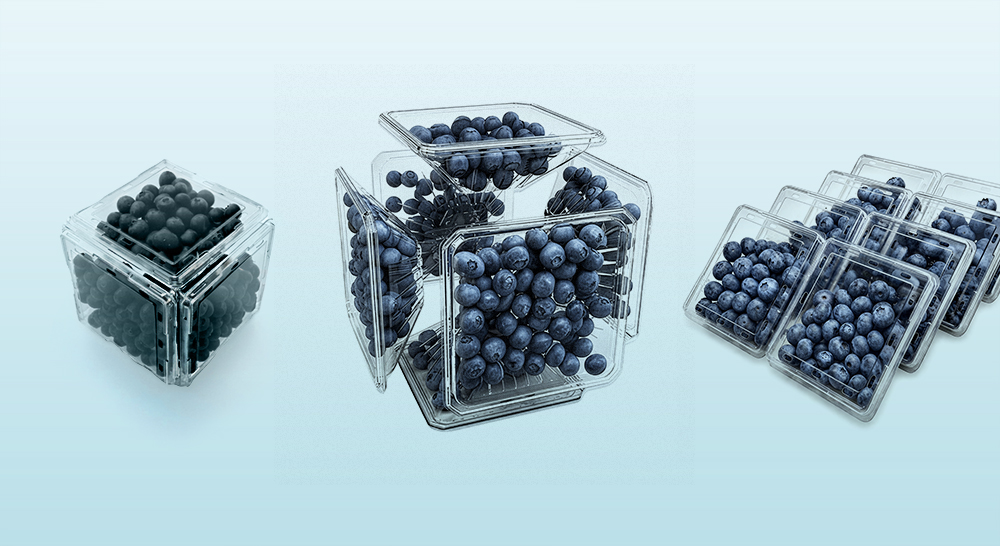
Q-Bic is a punnet for berries developed by AVI in collaboration with Smart Packaging Industries AS of Norway, and currently manufactured in India under license. Each unit has a pyramid shape and 45-degree side walls, allowing six punnets to be combined to form a cube.
“This geometry allows us to ship twice as many punnets per load and offers 100% greater fruit visibility compared to a conventional punnet. Thirty-six traditional punnets take up 34,8 liters, while 36 Q-Bic punnets take up only 17,1 liters. Less wasted space per shipment means fewer refrigerated truck and container movements per volume of berries exported,” Sethi stated.
Specific packaging for each fruit
AVI also developed a one-piece punnet for avocados, with a patented design.
“This packaging was specifically designed for the way avocados need to be packed, rather than adapting a generic clamshell for fresh produce. It reflects the same trend from another angle: packaging tailored to a particular fruit, not a one-size-fits-all format. Furthermore, it gives exporters access to a proprietary design that competitors can’t easily replicate,” Sethi noted.

Regulation and pressure in export markets
Sethi emphasized that the pressure is increasing most rapidly in export markets.
“European Union regulations, such as ESPR and the plastic tax, are driving EFSA-compliant recycled content requirements, which most Indian packaging manufacturers are not prepared to certify. Furthermore, importers are increasingly rejecting or holding shipments that cannot provide this documentation upon arrival,” he explained.
India also has its own requirements. Extended Producer Responsibility (EPR) regulations gradually raise the recycled content targets: from 30% in 2025/26 to 40% in 2026/27, 50% in 2027/28, and 60% by 2028/29. Progress is monitored through the CPCB's centralized EPR portal. If the target is not met, the brand owner must purchase equivalent quantity certificates to cover the difference.
“We stay ahead of both scenarios by using recycled content grades that already meet the direction of evolving requirements, backed by EFSA compliance through the Starlinger deCON line. This way, fresh produce exporters are not forced to requalify a new supplier every time regulations increase their requirements in any market,” he said.

Innovation in materials, design and certification
For Sethi, innovation in packaging encompasses everything from materials technology to precision manufacturing and format design.
“Innovation includes materials technology through Starlinger deCON, manufacturing precision to progressively reduce the amount of material per package without losing the barrier strength required for fresh produce, and format design through developments such as Q-Bic and the patented punnet for avocados,” he noted.
The executive added that consistent quality is reflected in repeated performance under real-world export conditions. In that context, he highlighted the Excellence Award given to AVI by Sahyadri Farms, India's largest grape exporter, for the performance of its export packaging.
“Discipline in certification means that all our certificates are kept up-to-date continuously, and are not renewed reactively. That is especially important for shipments of fresh produce crossing borders,” Sethi concluded.
Read also:
- Blueberry packaging: new requirements starting in August in the European Union
- Few gateways, different import networks: this is how Peruvian blueberries are distributed at their destination
- Active packaging aims to improve the transport of blueberries, reducing losses and extending their shelf life.
- Packaging 2.0: they invent hydrogel that delays fruit rot
- International Blueberry Seminars 2026: Blueberries travel through Peru, Chile, Mexico, Morocco and China
Previous article
Dynamics and damage analysis of blueberry fruit collisionsARTÍCULOS RELACIONADOS