Blueberries in China: Increased production and lower prices intensify competition
By: Natalia Rubio Iversen
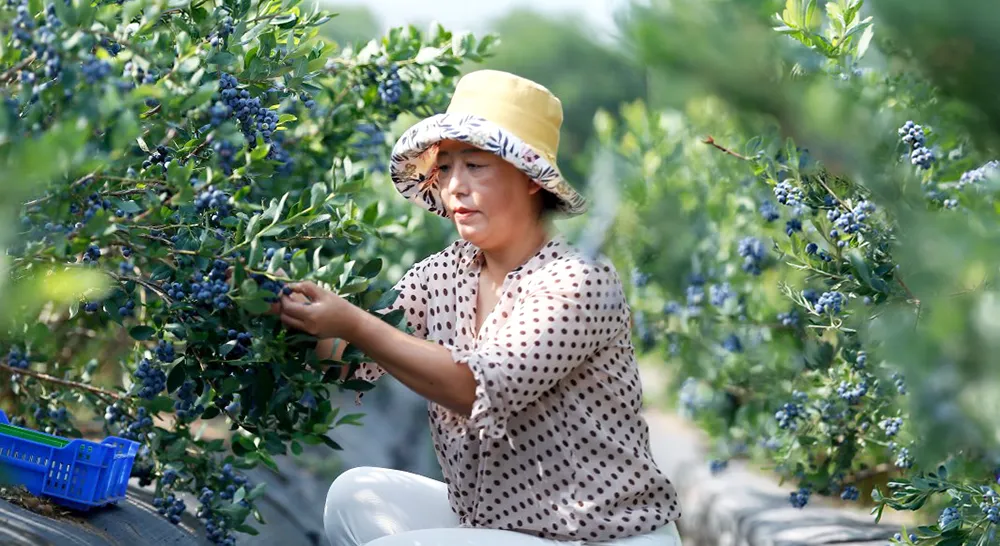
The prices of blueberries Yunnan producers are registering declines of nearly 50% this year compared to the previous season, according to data and testimonies collected by the Chinese media outlet Yicai from producers and commercial operators.
The correction comes after several years of strong production expansion. Between 2021 and 2025, the reported area of blueberries In the province, the area increased from about 100.000 to 300.000 mu —approximately from 6.700 to 20.000 hectares—, while production increased from 45.000 to 349.000 tons.
Volume, therefore, has grown much faster than area. The strong expansion of domestic production appears among the factors that the stakeholders consulted link to the progressive reduction in prices and to broader consumption of Blueberries in China.

The supply grows with a more intensive production model
Yunnan's expansion has not been limited to the addition of new hectares. It has been accompanied by a growing adoption of substrate cultivation, fertigation, protected cultivation structures, large-scale propagation, and more standardized processes.
This development has shaped a production model that is increasingly intensive in technology and capital, with a strong presence of companies that operate significant areas and systems geared towards greater control of production processes.
Yicai describes an industry in which substrate cultivation, mainly based on coconut fiber, and automated irrigation and nutrition systems have become commonplace among larger-scale projects.
The production structure has also changed. Along with international companies, Chinese companies such as Noposion, Xinrongmao, Kesida, and Haisheng Group have expanded their presence in Yunnan in recent years, contributing to the development of increasingly business-oriented and standardized production.
The expansion is beginning to be reflected in prices
Pressure is not only observed in general market references.
One example is the L25 cultivar, which has gained popularity in recent years. According to data from the agricultural platform Yimutian, cited by Yicai, it currently sells for around 50 yuan/kg, although with variations of between 10 and 30 yuan depending on size and quality.
A year ago, its prices were approximately between 100 and 120 yuan/kg, while two seasons earlier the opening values were between 150 and 180 yuan/kg.
This trend coincides with a significantly larger domestic supply and a more competitive market environment. The article also points to increasing competition among products with similar characteristics as fruit availability rises.

More competitive prices compared to a high investment
The pressure on prices takes on another dimension in an industry whose recent growth has required significant investments.
Noposion, one of the leading operators of blueberries In China, the comprehensive cost of establishing such projects has been placed between 70.000 and 100.000 yuan per mu, equivalent to approximately 1,05–1,5 million yuan per hectare.
The company operates more than 60 farms in blueberries in areas such as Honghe, Wenshan and Baoshan under a model that he calls "agricultural factory".
The pressure wasn't entirely unexpected. In September, Blueberries Consulting Noposion reported that it anticipated a more demanding pricing scenario towards the end of the season and was responding with earlier windows, a greater presence in large accounts and exports, in addition to cost adjustments.
The expansion enters a more competitive stage
The lower prices are already generating responses among some operators.
Producers and marketers interviewed by Yicai indicated that they have begun to expand their presence in raspberries, blackberries, and summer strawberries, seeking to diversify their offerings in the face of a challenging business. blueberry increasingly competitive.
Cheng Qingyun, a berry trader in Yunnan, believes that the cultivation of blueberries The underlying market is gradually entering a phase of more normalized returns, and this anticipates a possible market consolidation. In his view, new entrants will face greater risks, while operators with better sales channels could strengthen their negotiating power.
The testimonies collected by Yicai thus point to a stage in which, along with the growth of supply, cost control, quality, commercial windows and access to channels capable of capturing value acquire greater relevance.
Yunnan continues to expand its influence within China's industry. blueberryBut the scenario is beginning to change. With a larger supply and tighter prices, production efficiency, quality, and commercial capacity are gaining importance alongside volume growth.
Read also:
- Noposion brings forward harvests and expands exports in response to pressure on blueberry prices in China
- Driscoll's turns Yunnan into its regional berry platform for Asia
- SanLucar strengthens its presence in China with local production of premium blueberries
- Chinese blueberries are gaining ground in Southeast Asia thanks to genetics, quality, and business strategy
- Global blueberry production is growing and prices are showing resilience in the face of increased supply
- China: changing the rules of the global blueberry market
ARTÍCULOS RELACIONADOS