Driscoll's turns Yunnan into its regional berry platform for Asia
By: Natalia Rubio Iversen

Yunnan is taking on a new role in Driscoll's Asian strategy. What began 13 years ago as a production base primarily focused on the Chinese market is evolving into a source capable of supplying other destinations in the region as well.
This was stated by Jae Chun, Vice President and General Manager for Asia-Pacific and Emerging Markets at Driscoll's Global, in remarks to CGTN during the ninth China International Import Expo (CIIE) held in Shanghai. The executive explained that the company originally established itself in Yunnan under a strategic local for localbut which today considers the province a production base for both China and other Asian markets.
Driscoll's began production in Yunnan in 2013. A decade later, it began using that operation for exports to Hong Kong, Malaysia, and Singapore, markets in which it now seeks to further expand its presence.

Exports already show the change
According to information released by Asia Fruit Logistica, between January and May 2026, Driscoll's operations in Yunnan exported more than 2.500 tons of berries, for a value exceeding RMB 200 million, with year-on-year growth exceeding 40%.
At a regional scale, the company currently markets around 45.000 tons of berries in Asia, almost all of which are produced in China.
The operation in Yunnan has also grown. Driscoll's currently has around 4.000 hectares dedicated to the production of berriesdistributed across seven prefectures of the province. This area includes blueberries, raspberries, blackberries, and strawberries, so it does not correspond exclusively to blueberries.
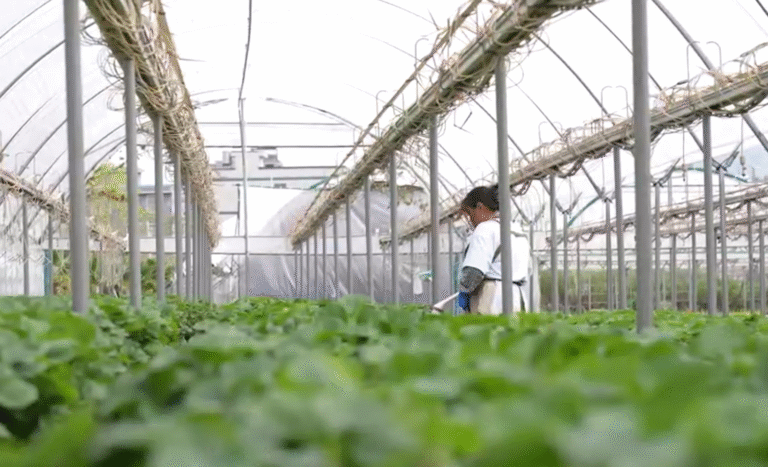
A farmer cultivates blueberries in Yunnan province, in southwest China. © CGTN Radio

Altitude and genetics allow for an extended productive window
Yunnan's diverse altitudes and agroclimatic conditions allow for staggered production with different varieties. According to Driscoll's, this combination allows for extending the production calendar. blueberry about nine months a year.
This facilitates the supply of Asian markets with fruit produced closer to the consumer.
Yunnan is also one of the main producing centers of blueberries from China and accounts for about 30% of national production.
Driscoll's has linked its Asian strategy to less reliance on long-distance routes and the possibility of improving the freshness and consistency of supply by producing closer to the destination markets.
Asia is increasingly producing for Asia.
Malaysia and Singapore are already part of that expansion. berries Products produced in Yunnan have been reaching those markets since 2023, so the next stage is aimed more at deepening those programs than starting from scratch.
The strategy is complemented by production in Laos, from where Driscoll's already supplies markets such as Singapore, Bangkok and Kuala Lumpur.
The move reflects a broader shift in the Asian market blueberryChina continues to be an important destination for blueberries imported, but Yunnan's productive growth is also turning the country into a source capable of supplying neighboring markets.
For Driscoll's, this transition transforms Yunnan into an increasingly important piece within its Asian strategy: a base that combines productive scale, genetics, altitude diversity and proximity to markets to support a broader regional offering.
Read also:
- Chinese blueberries are gaining ground in Southeast Asia thanks to genetics, quality, and business strategy
- Noposion brings forward harvests and expands exports in response to pressure on blueberry prices in China
- Agroberries accelerates its expansion in Asia: the Chilean giant is betting on its next big market
- Peruvian blueberries: Asia demands an increasingly segmented strategy
- Peru is diversifying its blueberry exports to India, Thailand, and Singapore
- China's Yunnan Province Unveils Honghe Blueberry Brand Strategy to Boost Industry Growth
- Driscoll's appoints chief operating officer and expands its global strategic structure
Previous article
XLIV International Blueberries Seminar Peru 2027next article
ARTÍCULOS RELACIONADOS