Global blueberry production is growing and prices are showing resilience in the face of increased supply
By: Alejandro Yoshioka
The world production of blueberries It reached approximately 2,33 million tons in 2025, an 11,2% increase over the previous year. Projections from the International Blueberry Organization (IBO) anticipate that the global volume of fresh and processed fruit could exceed 3,36 million tons by 2029.
So far, demand has kept pace with much of that growth. According to the border import prices used by the IBO as an international benchmark, global imports of blueberries Fresh production reached around 1,1 million tons in 2025, 13,2% more than in 2024, while the average price adjusted slightly to around USD 6,64 per kilo.
Even with this correction, prices show significant resilience in the face of strong volume growth over the last decade. Furthermore, in 2025, they behaved less erratically than in 2023 and 2024: the annual low was around USD 5,55 per kilo, and the high recorded during the Southern Hemisphere supply transition was lower and shorter than the peaks of the previous two years.

More hectares, more production
Growth continues to be driven primarily by the expansion of cultivated land. In 2025, the global area dedicated to blueberries reached 303.076 hectares, nearly 8% more than in 2024 and more than double the approximately 143.000 hectares recorded in 2016.
Of that total, 257.971 hectares were in production, leaving approximately 45.000 hectares yet to be incorporated into the supply. Of the production increase recorded in 2025, approximately 86% came from new hectares entering production and about 14% from yield improvements. The global average was around 9.045 kilos per hectare.
The recent expansion, therefore, continues to depend mainly on new land, while a significant portion of the area already planted has yet to be incorporated into the commercial volume.
Quality and segmentation
The increased supply is also occurring in a market that is becoming increasingly segmented by quality. Firmness, flavor, size, texture, appearance, and post-harvest life are gaining importance in the commercial differentiation of fruit.
The IBO cites an analysis of certain varietal groups in European and North American markets over 104 weeks, in which the lowest weekly price for standard fruit was 42% lower than that recorded for varieties categorized as premium.
In this scenario, genetics and varietal replacement take on a directly productive and commercial dimension. Breeding programs seek to combine consumer-oriented attributes with higher yields, resistance, specific growing windows, and adaptation to more efficient harvesting systems.
Segmentation is also observed in the destination of production: in 2025, approximately 77% of the global cultivated volume was destined for the fresh market and approximately 23% for processing.

Peru's role in America
Peru maintains a central role in the growth of American production. During the 2025/26 season, it registered 30.200 hectares planted, an estimated production of 407.800 tons, and exports of approximately 393.800 tons.
By 2029, the IBO projects that the country could reach around 604.000 tons, contributing more than half of the additional volume that America would add during the period.
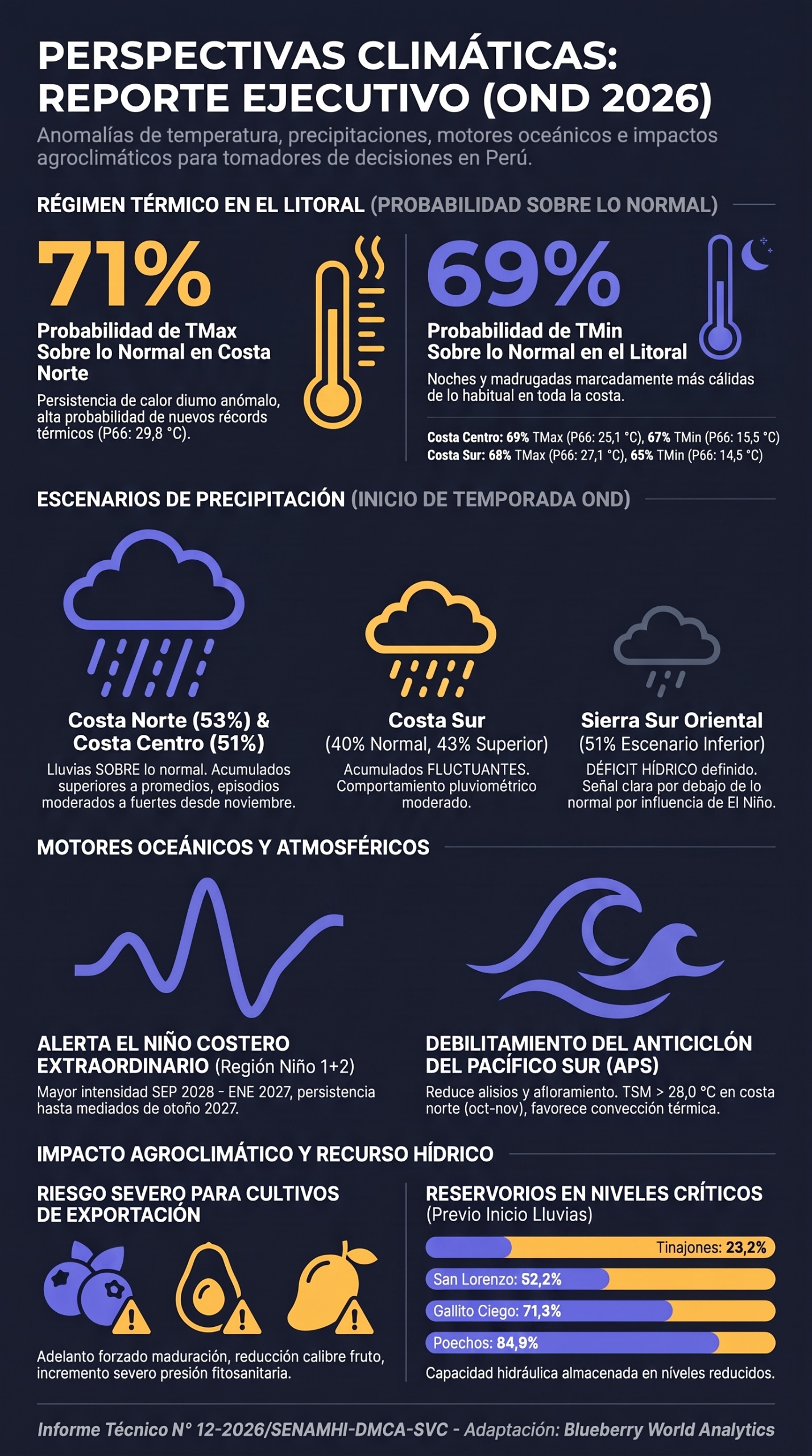
For 2026/27, the organization maintains its forecast for Peruvian production at no growth compared to the previous season, a conservative assumption in its model to mitigate the risk of El Niño. Among the challenges it identifies for the country are the development of new varieties, productivity, fruit quality, and increased pressure on costs and labor availability.
Chile and varietal replacement
Chile is progressing along a different path, marked by greater operational efficiency and varietal renewal. The IBO notes that some new plantations have lower capital and operating costs—excluding labor—than comparable projects in Peru.
Peru maintains a relative advantage in labor costs, although this gap is beginning to narrow due to increased pressure on availability and wages. This scenario reflects a shift in comparative advantages among countries of origin, where efficiency, productivity, and quality are gaining greater importance.
For Chile, the progress of varietal replacement and the improvement of yields will be key to maintaining competitiveness in the face of an expanding international supply.
China and the growth of Asia-Pacific
Asia-Pacific is the region with the highest projected growth by 2029. Its production would increase from approximately 810.000 tons in 2025 to more than 1,29 million, and would account for about 46,6% of the additional volume that the global industry would add during the period.
China accounts for most of that expansion. In 2025, it produced around 753.000 tons, and the IBO model projects that it could exceed 1,2 million tons by 2029, although the report itself warns that this estimate should be interpreted with caution due to land-use restrictions and other structural limitations.
The country is also beginning to modify trade flows: according to the IBO, China is already ranked as the fifth largest exporter of fresh blueberries to Asian destinations by volume and third by value.
Other origins are also advancing. Morocco, with a production close to 85.000 tons in 2025, appears among the countries with the greatest projected expansion towards 2029.
The introduction of new volumes and the growth of already established origins will extend the supply for more weeks of the year and increase competition among producers.
A greater supply towards 2029
So far, the market has absorbed a growing supply without a corresponding decline in prices. That relationship, however, will face greater pressure as new hectares come into production and global volume approaches the 3,36 million tons projected for 2029.
In this scenario, competitiveness will depend less and less on volume alone and more on the ability to produce fruit with quality, productivity, and costs compatible with market demands. Genetics, efficiency, and the ability to place that supply in destinations capable of absorbing it will increasingly differentiate between origins.
ARTÍCULOS RELACIONADOS