Chile changes its blueberry map: new varieties boost exports
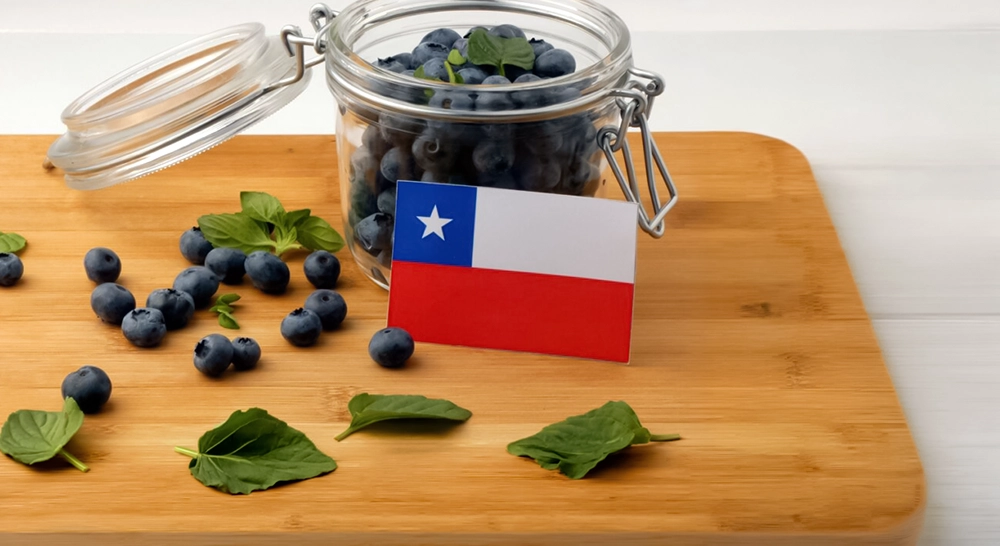
Chile closed the 2025/26 season with exports of nearly 92.900 tons of fresh blueberries, a year-on-year increase of 2,7% and a result exceeding initial estimates, according to the IBO Global Blueberry Report 2026. More than the growth in volume, the defining figure of the season is the transformation of the supply: shipments of new varieties increased by 14% and now represent 24% of the total, as the country seeks to regain competitiveness against Peru and other suppliers.
Varietal renewal responds to an increasingly demanding international market in terms of firmness, size, and post-harvest performance of the fruit. Chile maintains a significant export structure, but needs to adapt its orchards to sustain commercial programs in destinations with growing supply for much of the year.
Traditional varieties saw a slight decrease during the last season. In contrast, new genetics increased their share of shipments from 21% in 2024/25 to 24% in 2025/26, a change that is beginning to be reflected in the composition of exports.
The shift also coincides with significant changes among buyers. Europe received 46.768 tons, equivalent to 50% of Chile's fresh blueberries exported, and increased its purchases by 20%. The Netherlands increased its volume by 25%, and the United Kingdom by 5%.

Europe grows while shipments to the United States decline
European performance contrasted sharply with the United States, historically a key market for Chilean exports. That market accounted for 37% of exports, but received 13% less volume than in the previous season. The report attributes this decline to trade and tariff factors.
Canada showed the opposite movement, with a growth of 32%, while Asia ended the season with a reduction of 7%, mainly explained by lower shipments to China.
Within the Asian market, however, some destinations made significant progress. Taiwan increased its purchases of Chilean blueberries by 84%, and South Korea by 11%, demonstrating opportunities beyond the major traditional buyers.
Latin America also increased its share. Shipments to the region grew by 11,7%, with Argentina and Brazil as the main recipients.

Diversifying export destinations is becoming increasingly important for an industry that no longer competes solely on early market access. The condition of the fruit upon arrival, its post-harvest shelf life, and the consistency of the shipments are factors that carry increasing weight in importers' plans.
Another segment that showed growth was organic. Chile exported approximately 18.234 tons of fresh organic blueberries, 15% more than in the previous season, a volume equivalent to about one-fifth of fresh shipments.
Freezing absorbs more fruit and adds another outlet for production.
The transformation of the business is also evident outside the fresh market. Chilean exports of frozen blueberries reached 72.464 tons in 2025, a 46% year-on-year increase.
Processing is proving to be an alternative for fruit and varieties that no longer meet the requirements of certain fresh export programs. In this way, the industry can channel some of the production that faces greater difficulties competing in terms of quality or post-harvest condition.
The last season also had its own unique production characteristics. A greater accumulation of growing degree days brought forward and concentrated the harvest. The Duke variety began to be harvested approximately 20 days earlier than usual, although initially it showed lower dry matter content, smaller average sizes, and softer fruit.

The international report also incorporates a relevant element for assessing regional competition: some new Chilean plantations are reportedly registering lower capital and operating costs—excluding labor—than those observed in Peru. This data introduces an additional variable into a competition that, in recent years, has been characterized by the strong growth of Peruvian production.
However, cost alone will not solve the equation. For Chile, the possibility of maintaining and expanding its international presence will also depend on delivering fruit with consistent characteristics throughout the season.
The 2025/26 figures thus show an industry that is still growing in volume, but whose most profound transformation is taking place within the fields. Genetic renewal, European growth, and the expansion of frozen production are changing the structure of the Chilean blueberry business, while quality is once again crucial for competing in export markets.
Read also:
- Chile is beginning to show signs of repositioning itself in the global blueberry market
- Frozen products are gaining importance in the Chilean blueberry export offering
- Andrés Armstrong: “The Chilean blueberry industry is undergoing a transformation process”
- Frozen Blueberry Outlook in Peru: Strategies for Global Growth
- From Chile and Peru to Mexico: the technical conversation that responds to the challenges of the Mexican blueberry
- Gonzalo Salinas: "There is still room for Chile, but not for just any blueberry"
- Pilar Bañados: the transformation of the Chilean blueberry requires more than just new varieties
- The Port of Malaga boosts its international connectivity with companies from Chile and Peru
- International Blueberry Seminars 2026: Blueberries travel through Peru, Chile, Mexico, Morocco and China
ARTÍCULOS RELACIONADOS