Tangier focuses on the blueberry challenge: growing without putting pressure on the market
By: Martin Carrillo

The global supply of blueberries will continue to grow in the coming years. New producing countries are joining the major exporters, and the fruit is becoming more widely available throughout the year. At the same time, consumption still has room to increase, although the main markets are not showing the same capacity to absorb that growth.
The discussion marked the market presentations given this Wednesday at the 43rd International Seminar on Red Fruits Morocco 2026, organized by Blueberries Consulting in Tangier. Amine Bennani, president of the Moroccan Red Fruit Producers Association; Cindy Van Rijswick, specialist at Rabobank Research; and Álvaro Villalba, EMEA Business and Genetic Development Director at Hortifrut, addressed the evolution of supply, market behavior, and the factors that are beginning to play a more significant role in competition between origins.

Consumption still has room to grow
Van Rijswick anticipated that the global supply of blueberries will continue to increase. Peru will remain a significant player, but other exporters will also increase their volumes, and new players, including African countries and Egypt, will expand the amount of fruit available throughout the year.
This growth is occurring in a market where consumption is also continuing to rise. The Rabobank specialist placed European consumption of fresh blueberries at approximately 700 grams per capita, compared to around 300 to 350 grams in 2019. In Germany and the Netherlands, blueberry purchases have grown faster than the trend observed for all fruits and other berries.
In the UK, one of the most developed markets in the category, sales of fresh berries currently exceed £2.000 billion, while blueberries continue their growth trajectory. Asia presents a different situation: per capita consumption remains low, and even in China—the world's largest producer—frequent purchases remain concentrated among a limited segment of the population.
Van Rijswick also emphasized that consumption growth depends on maintaining a consistent supply. When fruit becomes unavailable in supermarkets, the possibility of further developing the category is also limited.

Cindy Van Rijswick, Rabobank Research @Blueberries Consulting
The United States and Europe send different signals
The comparison between the two main Western markets was one of the most relevant points of Rabobank's presentation.
In the United States, blueberry imports increased from less than 100 tons to more than 300 tons. Between 2017 and 2023, the volume nearly doubled, and despite this increase, the average import price remained relatively stable. Van Rijswick interpreted this trend as a sign of the US market's capacity to absorb larger volumes.
Europe has shown a different dynamic. During part of the period analyzed, the increase in volume coincided with a reduction in average prices. Van Rijswick warned that excessively rapid supply growth could put downward pressure on prices, especially in the European market.
The comparison introduces an important nuance for an industry whose production continues to expand: more consumption does not necessarily mean that all destinations can incorporate new volumes under the same commercial conditions.

More origins are entering the market
China is part of that transformation. Van Rijswick noted that the country has not only increased its production but also extended its season and expanded its exports to markets such as Southeast Asia, Central Asia, and Russia.
In this way, China is gaining a foothold as an exporter in destinations where other suppliers participate, adding a new element to a competition that no longer depends solely on the major traditional origins.
Amine Bennani brought this discussion to the Moroccan stage by reviewing the evolution of the country's soft fruit production and marketing. His presentation revealed a larger-scale industry, precisely at a time when differences in absorption rates between markets and the convergence of diverse origins are becoming increasingly relevant.
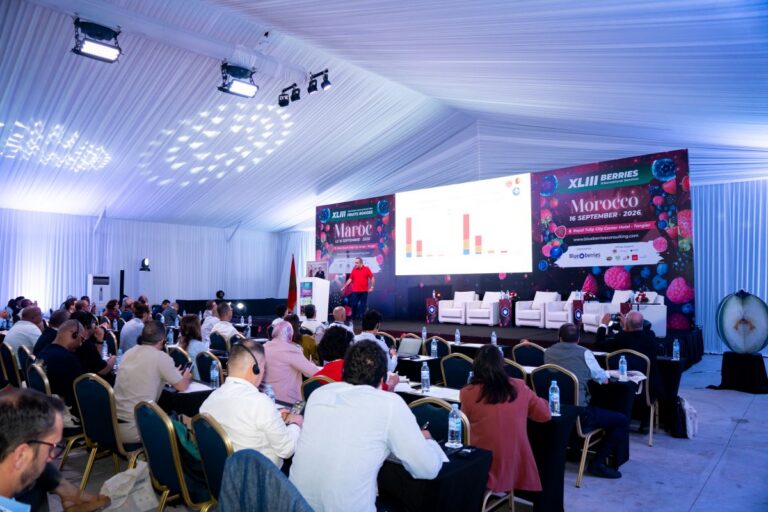
Amine Bennani, President of the Moroccan Red Fruit Producers Association © Blueberries Consulting
Proximity needs to be accompanied by courage
Álvaro Villalba's presentation added another dimension to the analysis: the relationship between commercial window, delivery time, genetics and fruit characteristics.
Morocco's proximity to Europe remains a logistical advantage over suppliers who must travel greater distances. However, its value changes as the weeks go by, other origins enter the market, and the Spanish season begins. The marketing window remains important, but the condition and characteristics of the fruit upon arrival also play a significant role.
At that point, Villalba positioned genetics as part of the commercial strategy, not merely as a production decision. The varietal selection must consider the target market, the time of arrival, the flavor, the quality, and the ability to maintain those attributes throughout the product's shelf life.
For Morocco, this combination opens up the possibility of adding value to its geographical advantage: genetics can turn a logistical advantage into a qualitative one as well, allowing it to compete not only for market access, but also for the characteristics of the fruit.

Álvaro Villalba, Director of Business and Genetic Development EMEA at Hortifrut ©Blueberries Consulting

Costs continue to put pressure on the equation
Van Rijswick added that energy, fertilizers, diesel, packaging, and logistics continue to put pressure on the supply chain. He estimated that the impact on berry costs could be around 3–5%, although he clarified that this does not necessarily imply a corresponding increase in the price received by the producer.
The scenario left by the presentations in Tangier thus combines two trends that are advancing at the same time: production and consumption continue to grow, but markets have different capacities to absorb that increase without affecting the value of the fruit.
For Morocco, proximity to Europe remains important. However, the exhibitions showed that genetics, quality, consistency, and timing of arrival are becoming increasingly crucial to capitalizing on this advantage in a market with greater supply and more origins competing throughout the year.
ARTÍCULOS RELACIONADOS