More supply, more demands: Cort Brazelton analyzes the new blueberry scenario at Fruit Attraction 2026
By: Natalia Rubio Iversen
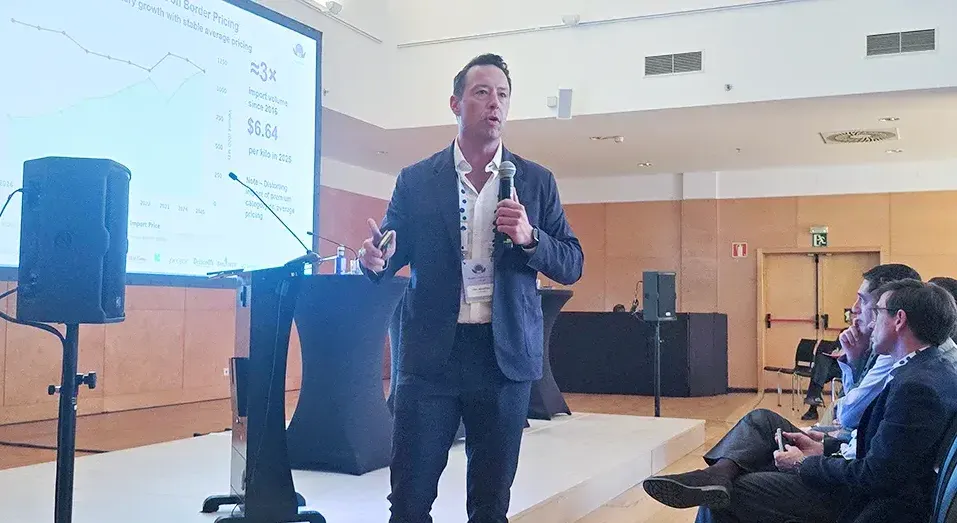
The global industry of blueberry It has managed to strongly increase production and trade over the past decade, while expanding demand and keeping average prices relatively stable as observed in aggregate international trade data.
Now a new test is approaching. Cort Brazelton considers it plausible that around another million tons will be added to global production by 2030 or in the years that follow, much of it coming from plantations that are already established but have not yet reached their full productive capacity.
Blueberries Consulting followed up its presentation during the International Blueberry Organization's (IBO) Blueberry World Forum & Cocktail, held at Fruit Attraction 2026. There, Brazelton argued that the next stage will depend not only on how much more the industry can produce, but also on its ability to efficiently produce, harvest, pack, and deliver that volume, generate sustainable returns for growers, and continue giving consumers reasons to buy more. blueberries.
Another million tons is still plausible
According to the IBO Global Blueberry Report 2026, in 2025 the global area of blueberry The area cultivated with highbush reached 303.050 hectares, of which 257.971 were in production. The volume reached 2,33 million tons, 11,2% more than the previous year.
The report also shows that most of that growth came from new hectares coming into production, rather than from an equivalent increase in field yields.
That point was central to Brazelton's reading: a significant part of the supply that will arrive during the next few years is already implicit in established fields that have not yet reached their full productive capacity.
“I still believe this increase of one million tons is plausible,” he said. But he immediately introduced a limit: “After that, I don’t think this curve will hold.”
This is not to say that global production will stop growing. Their warning is that the pace observed in recent years can hardly be sustained indefinitely. Land, water, input costs, labor availability, logistics, pest and disease pressure, and capital requirements are beginning to impose increasingly stringent constraints.
Brazelton also expressed concern about the industry's operational capacity to support growth of that magnitude: producing more fruit is not enough if harvesting, packing, logistics and marketing cannot absorb it with the same efficiency.
The IBO model incorporates this uncertainty into its projections. In Peru, for example, it used the assumption of no growth in the 2026/27 season to account for potential disruptions, including the possible influence of El Niño, based on past experience. This is not a prediction that Peruvian production will necessarily remain stable.
Another million tons is plausible. The question is under what productive and economic conditions it can be incorporated into the market.

Nine tons per hectare puts pressure on the business
That's where the second point Brazelton drew particular attention to comes in: productivity.
The IBO Global Blueberry Report 2026 places the global average yield of blueberry Highbush cultivated at 9.045 kg/ha during 2025. His reaction during the presentation was direct: “That is economic death, friends.”
Brazelton acknowledges that the methodology used to estimate an overall average yield has limitations. Even so, in his assessment, a level just above nine tons per hectare is extraordinarily low and well below the economic break-even point in virtually all producing regions.
For producers operating at or below those yields on productive plantations, the problem isn't just getting less fruit. It also becomes much more difficult to achieve competitive unit costs.
Hence Brazelton's emphasis on genetics, yield, and operational efficiency. If another large wave of production enters the market on a low productivity basis, the challenge ceases to be solely about how much to produce and also becomes about how much it costs to produce each kilogram.
The global average also masks significant regional differences. Brazelton particularly highlighted the performance improvements observed in Asia, while the report shows that there is still considerable room for increased productivity in various producing areas.
Productivity, however, does not guarantee that the new volume will find demand. To absorb an increasing supply, the industry also needs consumers to want to buy more.
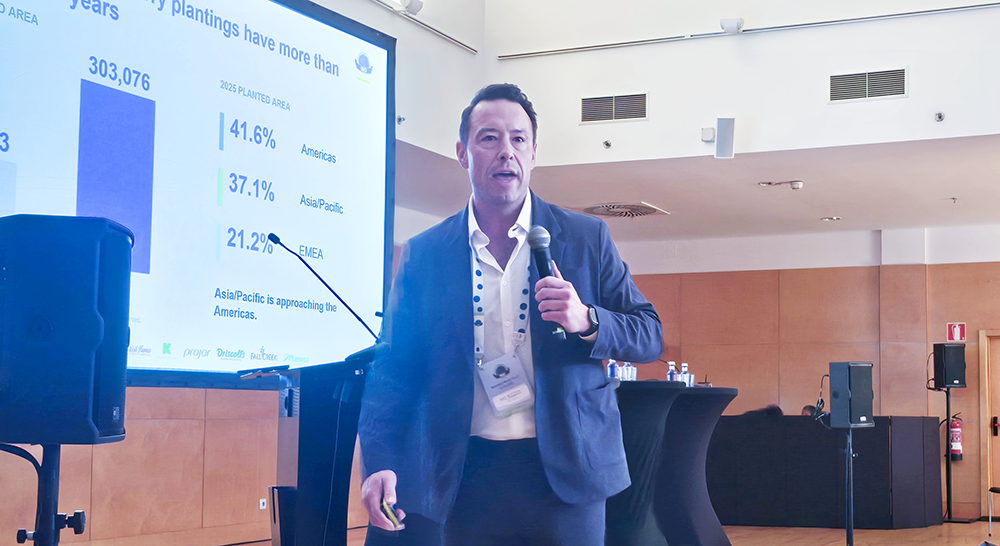
Cort Brazelton at the IBO World Blueberry Forum at Fruit Attraction. © Blueberries Consulting
More volume does not eliminate a lack of quality
It is at this point that Brazelton places quality. During his presentation, he returned to a category that the IBO calls “next-level quality”: fruit associated with newer genetics and a superior consumer experience. It is not simply about larger size. Flavor, texture, firmness, and other attributes are part of that differentiation.
For Brazelton, the importance of this fruit goes beyond simply obtaining a price premium. A better and more consistent consumer experience can encourage repeat purchases and help expand demand for a category that will have to absorb ever-increasing volumes.
The industry has already made enormous progress on another front: today it can offer blueberries for virtually 52 weeks of the year. What it has not yet managed to do is deliver an equally consistent supply of fruit with the highest quality standards during those same 52 weeks.
Brazelton noted that there is a significant presence of next-level quality for several weeks between October and April. In the period he specifically highlighted, between late October and November, that category can represent between 30% and 40% of the total supply.

During the Northern Hemisphere summer, however, market share can fall below 1%. This difference reveals an opportunity that goes beyond simply filling a sales window. If the industry can reduce this quality gap throughout the year, it can offer a more consistent consumer experience and, consequently, encourage repeat purchases.
This segmentation is also beginning to be observed in price behavior. In the aggregated cross-border trade data presented in Madrid, Brazelton noted that average prices in 2025, adjusted for inflation, were roughly at levels comparable to the peaks seen around 2016, despite strong growth in trade volume. He presented this as a general observation and not as a conclusion applicable in the same way to all markets or currencies.
But that average masks growing differences between categories. More than a specific price gap, Brazelton focused on what happens when supply increases: higher-quality fruit seems to maintain a firmer price floor, while conventional fruit becomes more vulnerable to sharp drops.
A source cited in the IBO Global Blueberry Report 2026 summarizes it this way: “Premium fruit has a floor; commodity fruit, a precipice.” The idea points to the different behavior of both categories when supply increases; it does not imply a fixed premium nor does it equate premium with jumbo fruit.

Cort Brazelton at the IBO World Blueberry Forum at Fruit Attraction. © Blueberries Consulting
Comparative cost advantages are also beginning to change
The ability to produce fruit with desirable attributes also depends on the cost per kilogram. Cost structures remain highly variable across regions, but Brazelton cautions that these differences are not static.
During much of the recent expansion, regions with low or zero cold requirements, such as Peru, Mexico, or Morocco, grew supported by advantages such as rapid entry into production, competitive labor structures, and conditions that favored certain production models.
Those origins will continue to play a central role in the industry, but some of the conditions that fueled its growth are changing. Input and labor costs are rising, water faces greater restrictions in various regions, and sanitation, logistics, and capital requirements are also increasing.
At the same time, traditional producing regions can improve their position through new genetics, higher yields, labor efficiency, mechanization, and better production management.
Brazelton therefore suggested that signs of some kind of equilibrium in unit costs might begin to appear. This does not mean that the advantages between origins have disappeared, but rather that the competitive position of each region will depend less and less on its historical cost and more on how much it manages to produce, with what efficiency, and with what quality.
This move brings the discussion back to square one. The industry has demonstrated over the past decade that it can significantly expand supply while simultaneously growing the market. But the next cycle is not guaranteed by volume alone.
The opportunity remains enormous, but sustaining the next stage of growth will require greater productivity, better economic results, and a more consistent consumer experience, so that expansion remains sustainable for both those who produce the fruit and those who ultimately buy it.
Read also:
- IBO World Blueberry Forum: More supply, less margin for error, the blueberry changes scale at Fruit Attraction 2026
- Blueberries in retail: price matters, but it's not enough to generate repeat purchases
- Fruit Attraction 2026: Surexport warns that blueberry production is growing faster than consumption
- North Bay Produce: Genetics, productivity, and condition raise the bar in the blueberry business
- The threat of commoditization in the global blueberry
- Fall Creek is committed to genetics that connect fruit quality, consumption, and profitability
- Diego Castagnasso: the profitability of blueberries today depends on timing
ARTÍCULOS RELACIONADOS