Netherlands: Differences in firmness and shelf life of blueberries complicate their marketing
By: Martin Carrillo
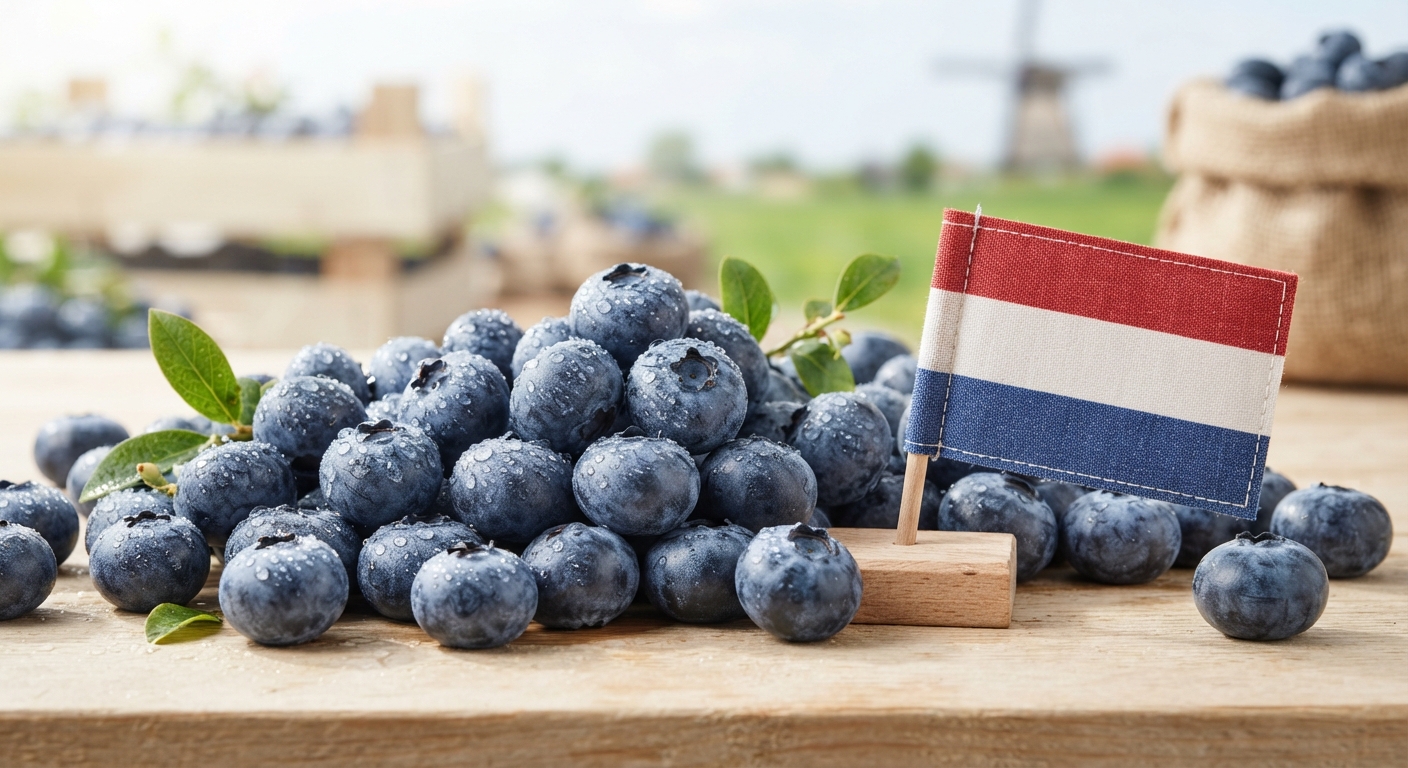
The differences in firmness and lifespan between certain batches of blueberries Imports from South America and southern Africa are making it difficult for some importers in the Netherlands to plan inventories and deliveries.
According to statements from a Dutch importer reported by FreshPlaza, supply has been limited since the start of the overseas season and prices have remained high for several weeks. This is compounded by difficulties in managing the storage of some shipments, whose condition can vary from week to week and even present unexpected problems during storage.

Variability between shipments requires commercial adjustments
As one of the main entry and redistribution hubs for fresh fruit into Europe, the Netherlands relies on precise management of trade times. Shipments with a shorter remaining shelf life require faster turnover, while those with better preservation offer greater flexibility in organizing deliveries.
Firmness is one of the main quality attributes of blueberryHowever, this alone is not enough to determine how long it can be kept under suitable commercial conditions. The variety, harvest maturity, handling, and continuity of the cold chain also influence its preservation, according to technical background information from the Centre for the Promotion of Imports from Developing Countries (CBI).
The difficulties described in the Netherlands do not necessarily represent the general condition of the blueberries South Americans. William Hill, of Colina Fruits, said his company had received good quality Peruvian fruit in various sizes, including blueberries larger than 18 millimeters and 14 and 12 millimeter sizes. Hill highlighted the consistent quality observed in his supplies and noted that Peru continued to be a preferred source for the company.

High prices and changes in marketing
Limited availability of blueberries This has coincided with prices that operators describe as high, although lower than the peaks recorded in previous seasons.
According to FreshIntel, on October 27th the asking price of the blueberries In the Netherlands, the price reached €16,20 per 1,5-kilogram package, equivalent to €10,80 per kilogram, 3,6% lower than on September 29. This indicator reflects commercial offers under DDP terms, not necessarily prices of completed transactions.
Given these price levels, many Colina Fruits customers were opting for smaller, more frequent purchases, William Hill explained. This strategy aimed to maintain product freshness and facilitate efficient stock turnover.
Trade changes are also evident in the relationship between producers and intermediaries. The Dutch importer noted that some producers were choosing to sell their fruit directly rather than through trading companies. However, he acknowledged that it was unclear whether these decisions were a response to current prices or to longer-term shifts in trade relations.
Peru and Chile: expectations for year-end supplies
In addition to the difficulties in managing the condition of certain shipments, there is uncertainty about the supply in the coming weeks, especially given the lower export projections from Peru.
In its sixth projection, published on October 14, Proarándanos estimated that Peru would export 344.000 tons of blueberries Fresh produce exports for the 2026/27 season are projected to be 10,3% lower than the previous season. For weeks 41 to 53, the industry projected exports of 133.500 tons, a year-on-year decrease of 24,7%.
These estimates correspond to all Peruvian shipments and do not represent volumes destined exclusively for the Netherlands, although they constitute a relevant background for evaluating international availability during the last quarter of the year.
While Peru projects lower shipments, Chile anticipates a slight expansion of its fresh produce exports. Blueberry Committee Chilean Fruits adjusted its forecast for the 2026/27 season to 94.071 tons, 1% above the previous season, although 3% less than its initial estimate.
The transition between these two origins will be especially important for European importers. The Dutch operator expressed concern about availability during the last weeks of November and the first weeks of December, while Chilean shipments are expected to gradually increase their share of international supply.
With fruit availability under pressure during the last weeks of November and the first weeks of December, importers will be paying close attention to both the increase in Chilean shipments and the condition in which the next shipments arrive, in anticipation of pre-Christmas trade commitments.
Read also:
- South Africa is making strong progress: the United Kingdom, the Netherlands, and the United Arab Emirates are leading the way.
- Europe maintains high demand for blueberries, but quality defines the market.
- Long-distance blueberries: quality doesn't end at harvest
- Jessica Rodriguez: Reducing the time between harvesting and cooling will be key to protecting the firmness of blueberries
- Fred Douven: “The next phase of blueberry expansion is just beginning”
- Egyptian blueberries: volume is growing, but value depends on destination
- Ukraine redirects its blueberry exports to the Netherlands and reduces its dependence on Poland
Previous article
Advanced Detection Techniques Using Artificial Intelligence in Processing of Berriesnext article
ARTÍCULOS RELACIONADOS