María del Carmen Salas: “Nutritional balance and timely control are key in blueberry management”
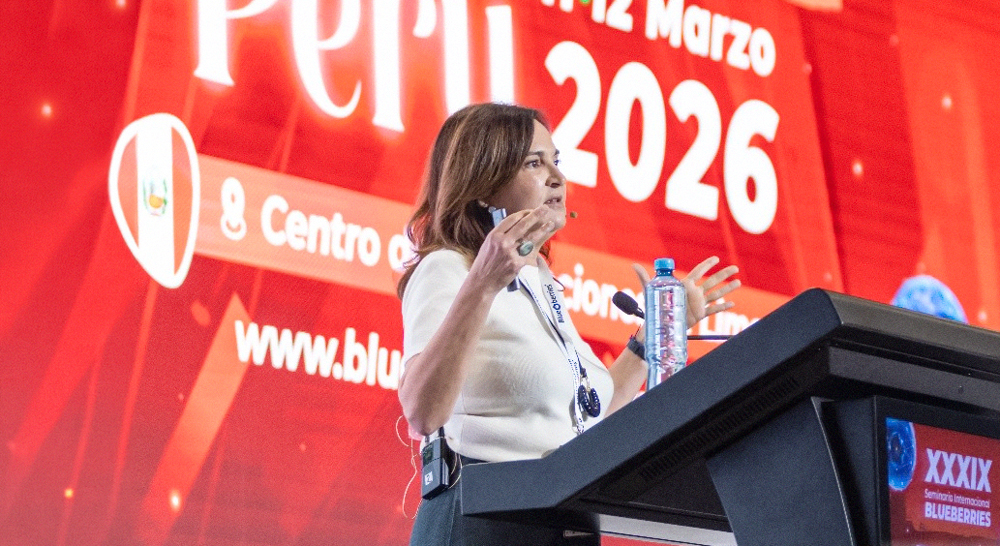
The XXXIX International Blueberries Seminar Lima 2026 once again brought together international leaders in the industry blueberry, entre ellos María del Carmen Salas, researcher and professor at University of Almería, who contributed his experience in nutritional management and control of variables in intensive systems.
During the sessions, various technical challenges facing the industry in maintaining competitiveness and fruit quality were addressed. In this context, Salas emphasized the need to precisely manage the plant's chemical balance and to promptly monitor crop changes, understanding that the firmness and final condition of the blueberry depend not only on genetics but also on the quality of management.

—How have you experienced this in Peru?
Luckily for me, I've been back several times and I almost feel at home. Everything is very well organized, as always. The response from people is impressive, both from companies and professionals and technicians, and that gives us the opportunity to exchange a lot of valuable information.
—How does magnesium influence competition for exchange sites and the final firmness of the products?
It's a complex question, a really difficult one. To simplify, I'd say that, like any cation, elements such as magnesium, sodium, and potassium compete very directly because they all have a positive charge. Therefore, maintaining nutritional balances as recommended or published is the most appropriate way to prevent calcium from interfering with magnesium absorption, or vice versa.
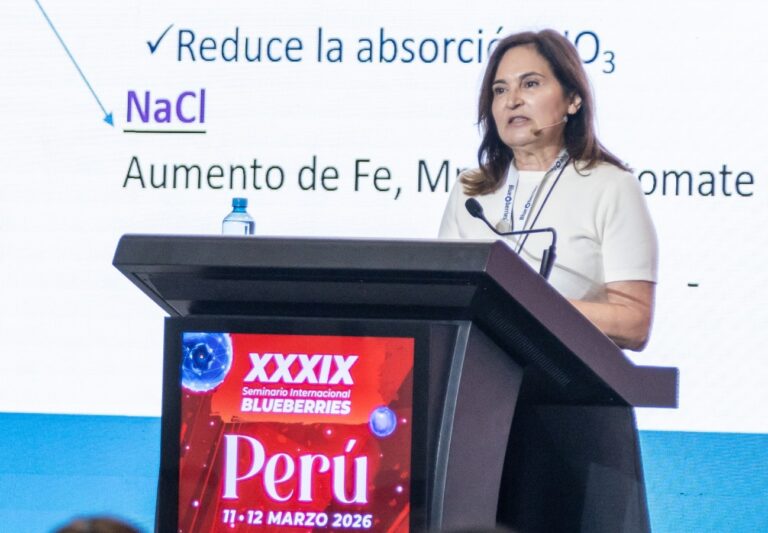
María del Carmen Salas, researcher and professor at the University of Almería, at the XXXIX International Blueberries Seminar Lima 2026. © Blueberries Consulting

—Do you think that an excess of nitrogen dilutes structural calcium due to increased cell growth in the fruit?
I would say that, in principle, no. What does happen is that when a plant exhibits very rapid or excessive vegetative growth, it also generates a high demand for calcium, because the vegetative parts are the ones that require it the most.
So, calcium is sacrificed in the fruit because it's directed to the more demanding parts, like the leaves and stems. And that can indeed lead to calcium deficiency in the fruit, which is precisely where maintaining calcium levels is also important. That's why it's crucial to always be mindful of maintaining a delicate balance and prevent the plant from growing too rapidly. Ideally, development should be proportionate and at an appropriate pace.
—What would you recommend to the producers who are watching us?
Above all, I would recommend very strict monitoring of the concentrations of the main cations and anions, both in the drip irrigation system and in the drainage system, and obtaining that information as quickly as possible. What we generate today, we should be able to observe today.
Furthermore, it's important to have an overview of how the crop evolves over time, to monitor the plant's behavior at specific levels on a daily basis and make timely adjustments. Sometimes the problem is that we have a lot of information, but we process it with a delay. And when data arrives a week late, it might help explain an error, but it's no longer enough to prevent it.

Participation in Lima 2026
María del Carmen Salas participated in the XXXIX International Blueberries Seminar Lima 2026 with the talk “Tools for controlling nutrition and salinity in blueberry production in pots”, presented in the main hall during the second day of the event.
His presentation reinforced a central idea for the industry: in intensive systems of blueberryMaintaining quality and productive stability increasingly depends on the ability to monitor, interpret and correct key variables of nutritional management and the root environment in a timely manner.
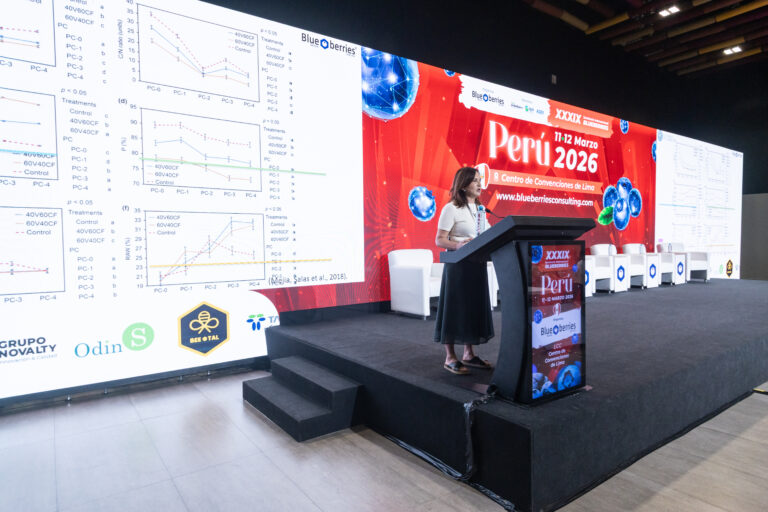
María del Carmen Salas, speaking at the XXXIX International Blueberries Seminar Lima 2026, presenting “Tools for controlling nutrition and salinity in potted blueberry production.” © Blueberries Consulting
Read also:
- Nutrition, salinity and monitoring: practical keys left by María del Carmen Salas at Lima 2026
- Technical Tour Lima 2026: field, criteria and lessons learned applied to the blueberry industry
- “There is a need to develop crops that use nutrients more efficiently.”
- International Blueberry Seminars 2026: Blueberries travel through Peru, Chile, Mexico, Morocco and China
Check out the full interview on our channel. Youtube Blueberries TV
Previous article
The blueberry in the midst of a world in crisisARTÍCULOS RELACIONADOS