Phytohormones in the blueberry production process

Phytohormones, or plant hormones (PH), are chemicals produced by the plant that are important for the growth, flowering, and fruiting of blueberries. Their balance and function are crucial for obtaining high-quality fruits. In this regard, the conference "How phytohormones regulate the growth, flowering, and fruiting of blueberries" was held by Thomas Fichet, professor at the Department of Agricultural Production of the Faculty of Agricultural Sciences at the University of Chile.
Professor Fichet's presentation took place at the XXXVII International Blueberries Seminar Trujillo 2025 by Blueberries Consulting.
They regulate the life cycle of the plant
Fichet noted that phytohormones regulate all stages of a plant's life cycle, influencing processes such as cell division, cell expansion, fruit ripening, and leaf fall, which are involved in the growth, flowering, and fruiting of blueberries.

Regarding phytohormones and their relationship to production, Fichet mentioned that each organ of the plant has a different sensitivity to a phytohormone. And there is a specific concentration for maximum stimulation.
He also emphasized that every plant cell has the capacity to produce all phytohormones. In this sense, plant hormones operate at very low concentrations.
Plant hormones and how they act
Among the plant hormones that influence plant growth are auxins, cytokinins, brassinosteroids, gibberellins, and strigolactones. Plant hormones related to stress response include ethylene, salicylates, and jasmonates.
Phytohormones do not act in isolation. Each stage of plant development is the result of the interaction of several of them, which can complement or counteract each other. Even the same plant hormone can provoke different responses depending on the organ it acts on or the stage of that organ's development.

The combination of phytohormones can influence different stages of a plant's life cycle. For example, auxins, cytokinins, and gibberellins, in combination, are important for floral induction and flower development.
The organ that produces the greatest amount of phytohormones is the fruit.
In every plant growth and development process, there are always phytohormones that promote it and others that suppress it. Therefore, it is important to finely control whether the process occurs and at what speed.
Some phytohormones
- Auxins:
They promote cell division and expansion, contributing to the growth of stems, roots, and fruits. They also stimulate bud formation and the production of other hormones.
- Gibberellins:
Along with auxins, they are involved in stem and fruit growth. They can also influence flowering.
- Cytokinins:
They stimulate cell division, especially in lateral shoots, and promote flower formation, acting in contrast to auxins.

- Abscisic acid (ABA):
It can inhibit growth and participate in the senescence (aging) of leaves and fruits.
- Ethylene:
Although it is a gaseous hormone related to fruit ripening, it can also inhibit growth and participate in the fall of leaves and fruit.
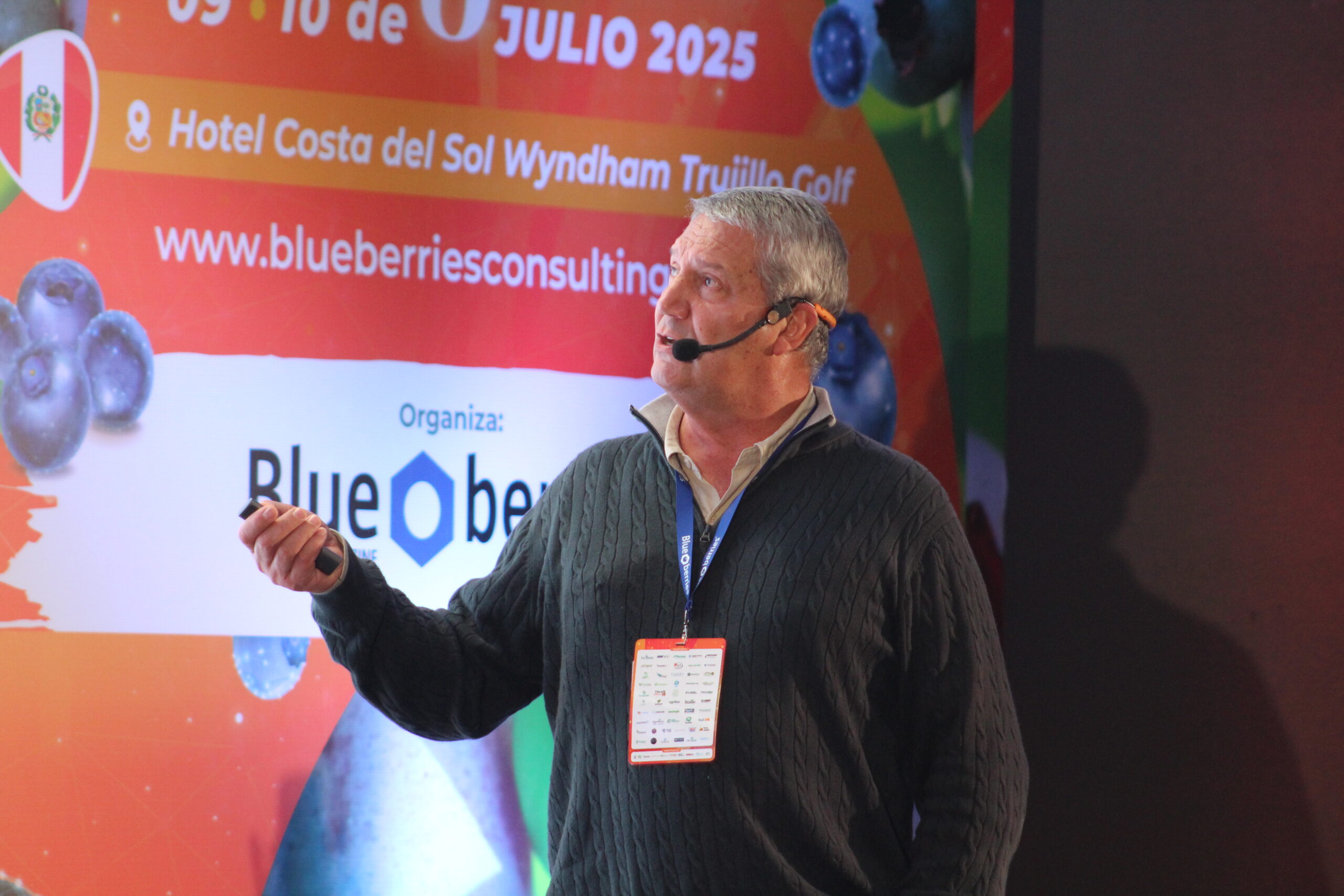
Photography by Blueberries Consulting – Mr. Thomas Fichet, Agricultural Engineer, Ph.D., Professor, Department of Agricultural Production, Faculty of Agricultural Sciences, University of Chile
Care in agronomic management
Fichet points out that poor agronomic management alters the synthesis of plant hormones (lack of light, excess water, soil salinity and aeration, excess or deficiency of nutrients, etc.) because the plant must adapt to the stressful condition to which it is being subjected, decreasing phytohormones linked to growth and increasing those that adapt to stress.
If plants are exposed to stressful conditions, the fruit will not have optimal characteristics; growth and ripening will be uneven, and its quality will decline. However, if phytohormones are applied at the right times, better results will be achieved, especially in terms of fruit quality.
Continue on World Blueberry Tour el Wednesday September 10 ’s relationship with the 2025th International Seminar on Red Fruits, Morocco XNUMX and technical tour where we will visit production fields in the North of the country Thursday, September 11.
Ask about available STANDS and SPONSORSHIPS HERE
Get your ticket to the MOROCCO SEMINAR and TECHNICAL TOUR HERE
Previous article
Optimistic outlook and strategic challengesARTÍCULOS RELACIONADOS