Dubai strengthens its position as a regional hub for fresh produce
Dubai has announced the development of the Food, Fruit, and Vegetable Market, a facility that aims to become the world's largest of its kind and further enhance the UAE's appeal as a trading hub for fresh produce. The project—driven by Dubai Municipality in partnership with DP World—will double the capacity of the existing market and establish more direct connections to global markets.
To understand what this leap means for the region (and for categories such as blueberries and red fruits, where the cold chain and continuity of supply are crucial), Fruitnet spoke with Redha Mansouri, CEO of Fresh Fruits Company (FFC), and Hesam Rahi, CEO of Farzana Trading.
What is the market like in the UAE and the Gulf?
Redha Mansouri (FFC): The region remains strategic and attractive. In a context of higher production costs and volatile freight rates, collaboration among suppliers, importers, and retailers is strengthening. The Gulf market remains dynamic and resilient, supported by increased health awareness and the expansion of retail trade. Demand remains strong, sustaining interest in investment and innovation across the entire value chain.
Hesam Rahi (Farzana Trading): With population growth and sustained development in the Gulf countries, we are seeing an expansion of the fresh produce sector. The United Arab Emirates maintains a central role as a regional platform due to its location and the quality of its ports and logistics infrastructure.

What changed after Covid-19?
Redha Mansouri: The pandemic accelerated changes that are here to stay: digital adoption, the growth of online platforms and fast commerce, with rapid deliveries of fresh produce. At the policy level, the UAE has reinforced its focus on food security and local agriculture, with investments in climate-controlled agriculture and measures to reduce dependence on imports in key categories. All of this opened new opportunities and redefined priorities.
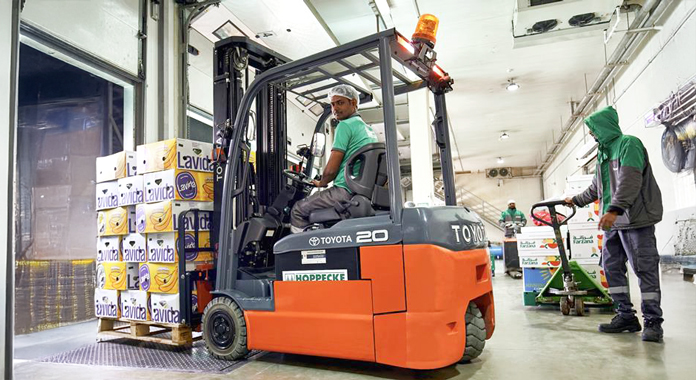
Hesam RahiAt Farzana, we currently supply significant volumes to online businesses, in addition to operating our own e-commerce channels. Consumption patterns have also changed: there is a growing preference—especially among younger consumers—for pre-packaged formats, due to their convenience, hygiene, and portion control. This trend is reshaping how we present, package, and market products in both physical and digital retail, including delicate fruits like blueberries.
What do they expect from the new fresh produce market?
Redha MansouriThe Dubai Food District, developed in partnership with DP World, will double the market's size and further connect it to global flows. For established operators, this is positive: improved infrastructure, a modern cold chain, and more streamlined processes increase efficiency and enable scalability.
Hesam Rahi: For us, this is a concrete opportunity to strengthen our position. Dubai already operates one of the most modern markets in the region, and with even more advanced facilities, it will continue to set the standard for efficiency and service.
Where are you seeing growth?
Hesam RahiIn Farzana, we experienced strong growth in our direct business, shipping from origin to multiple destination ports. Today, we export to over 30 countries and have seen significant progress driven by demand for our premium brand, Lavida, which has a presence in the Gulf, Central Asia, and North and East Africa. In the MENA region, brand recognition has been a clear driver of volume growth.
Redha MansouriGrowth is particularly noticeable in neighboring Gulf markets, where demand for high-quality, branded fresh produce is increasing. Brands have always been central to FFC's identity, with long-term partnerships. Our portfolio includes Chiquita, Zespri, Jazz, Pink Lady, and Envy. In addition, Frutia is our private label for various market segments, and Hello Fruits is our consumer-oriented brand for fresh juices and freshly cut produce, with kiosks in Carrefour hypermarkets strengthening our local presence.

What are they importing and what are they looking for going forward?
Redha Mansouri: FFC works with a highly diversified portfolio: we import over 500 products year-round from more than 60 countries. Our categories include bananas, pineapples, apples, citrus fruits, kiwis, grapes, blueberries and other berries, leafy greens, tomatoes, and niche products. Our strength lies in identifying emerging origins and products early. We see potential in premium and value-added categories, and in origins that can offer consistency, quality, and sustainability.
Hesam Rahi: At Farzana's Fresh Division, we import over 1.000 SKUs and pack and supply more than 20 categories under the Lavida brand. A recent milestone was securing an exclusive partnership with Madagascar to be the sole distributor of Malagasy lychee in the Middle East, Turkey, and North Africa.
Main challenges: logistics, climate and sustainability
Hesam Rahi: A major challenge today is the extended transit times caused by the situation in the Red Sea, which primarily affects shipments from Europe and South America. Longer journeys increase the risk of quality variations and market volatility, and can strain supply continuity. Furthermore, delays and irregular arrival patterns—with weeks of double or triple arrivals—complicate planning and inventory management. In sensitive categories like blueberries, these disruptions are felt acutely.
On a broader level, climate change is affecting production regions and cycles. Through diversified sourcing and proactive planning, we aim to reduce risk and maintain quality and availability.
Redha Mansouri: Sustainability is becoming central, driven by environmental concerns and consumer expectations. Price and quality remain key, but there is growing attention to responsible sourcing, food safety, packaging, and waste reduction. Many of our products are GlobalGAP certified, reflecting our commitment to traceability and best practices.
Is Dubai regaining its role as a regional hub?
Redha MansouriDubai hasn't lost its position, but it is reasserting it even more strongly. Although some countries import certain products more directly, Dubai's advantages remain clear: world-class ports and airports, efficient logistics, modern storage and cold chain facilities, and a stable regulatory environment.
Hesam Rahi: I agree: Dubai's position has not weakened. Its connectivity with the Middle East, Africa, Central Asia, and even Europe keeps it at the heart of regional and international trade flows.
Long-term look
Hesam Rahi: With decades in the business, we've weathered cycles, disruptions, and changes. That experience, combined with strong relationships with producers and logistics partners, gives us the flexibility to adapt and grow.
Redha Mansouri: For over 50 years, FFC has faced economic, geopolitical, and industrial challenges that have strengthened its resilience. This allows us to look to the future with confidence.
Finally, Mansouri noted that he was recently elected chairman of the Dubai Chambers of Commerce and Industry and recalled that FFC also developed The Fresh Market, a wholesale and office complex next to the Dubai Fruit and Vegetable Market, designed to complement the existing operation, create jobs and reinforce the city's role as a regional hub for fresh produce trade.
ARTÍCULOS RELACIONADOS