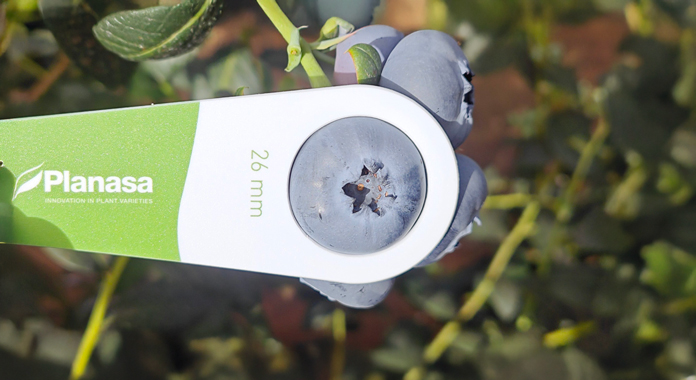
Blueberry: Four applied studies are now available for download from Blueberries Consulting

As part of the technical content that Blueberries Consulting The portal now publishes four studies recently added to the collection, which are now available for download. Studies section, where users can find research publications, essays and analyses organized by thematic categories, in a repository that is updated weekly.
The selection focuses on challenges that currently define competitiveness in blueberry: measure quality more objectively, sustain performance under adverse conditions, and improve accuracy in harvesting and fruit selection decisions.
With over a decade of content, the library brings together information on agribusiness and marketing, blueberries and health, quality and post-harvest, physiology and genetics, pests and diseases, agricultural chemistry, irrigation and water management, soils and substrates, sustainability and environment, as well as technology and innovation, among other topics.
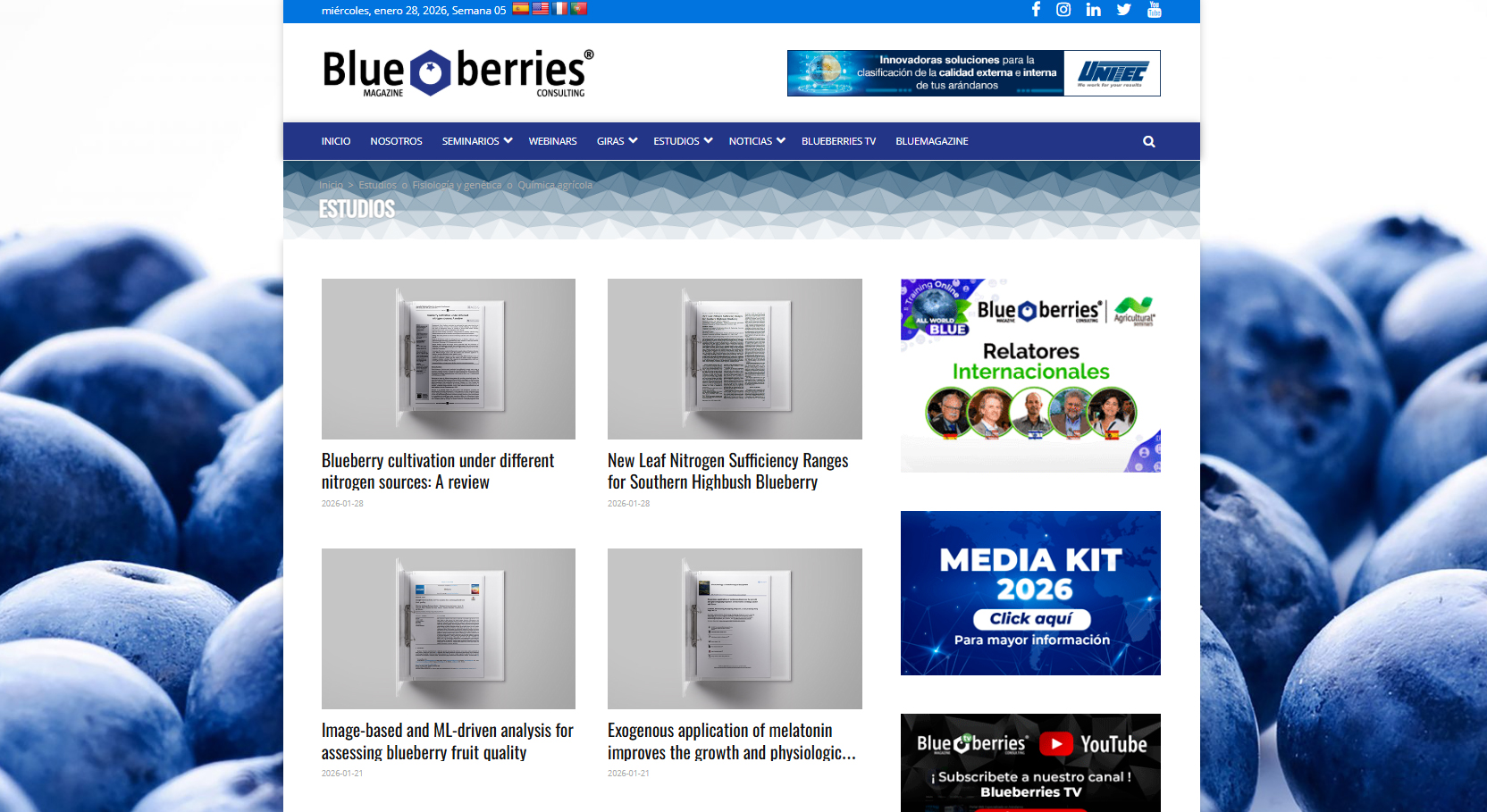

With the divulgation from these studies, Blueberries Consulting It reinforces its purpose of sharing specialized knowledge and delivering useful scientific and technical evidence for producers, advisors, technicians and professionals in the field.
In this way, the January selection focuses on the technical and commercial conversation of blueberryHow to assess quality more quickly and at a lower cost, how to respond to abiotic stress such as salinity, what new hypotheses are emerging about pollination and fruit set linked to nighttime activity, and how to advance automation with models capable of detecting maturity in real orchard conditions, where occlusion and environmental complexity often hinder assessment.

The four studies, in brief
Quality assessment using images and machine learning
This study proposes a non-destructive method for estimating quality parameters using image analysis and machine learning models. The approach is based on RGB images captured with mobile devices and algorithms that predict variables such as soluble solids and firmness, improving predictive capacity by incorporating the machine learning component. For producers and exporters, the value lies in moving towards more frequent and standardized monitoring, with less reliance on destructive sampling and laboratory testing.
Exogenous melatonin and seedling performance under saline stress
This study evaluates how the growth and physiological response of blueberry seedlings change when melatonin is applied under saline stress conditions. The results describe improvements associated with the treatment, including reduced oxidative damage and a more favorable ionic balance. As evidence, it offers a useful starting point for guiding local trials and technical discussions on stress mitigation strategies, both in nurseries and during early establishment stages.
Evidence on night pollination in blueberries
The research opens a relatively unexplored line of analysis in agriculture: the possibility of nocturnal pollination. It presents evidence of nectar availability at night and observations of blueberry pollen in moths captured on farms. Although its relative importance compared to daytime pollination still requires further investigation, the immediate contribution is to broaden the approach used to evaluate pollination services and incorporate biodiversity and management variables that could influence fruit set.
Orchard maturity detection with a lightweight model
The GLL-YOLO study presents a lightweight network designed to detect fruit maturity under real-world farm conditions, where dense clusters, occlusion, and complex backgrounds typically reduce accuracy. It proposes improvements over a YOLO architecture and reports advances in both performance and computational efficiency, making it suitable for edge devices. For the industry, this represents a significant step toward tools that support fruit harvesting and sorting using more objective criteria.
The four documents are now available for download at the Studies section de Blueberries ConsultingReviewing them allows for the identification of specific approaches to strengthen decisions in the field and in export, and to closely monitor the evidence that is added monthly to the repository.
Previous article
Peru opens its doors to the bumblebee Bombus atratusARTÍCULOS RELACIONADOS