Zimbabwe, a new player gaining strength in the blueberry industry

The blueberry industry is experiencing steady growth worldwide. Peru has positioned itself as a leading exporter, but other emerging players, such as China, the United States, and Chile, are also gaining momentum. However, Zimbabwe, from Africa, has emerged as an alternative, gaining momentum in the last year.
In Zimbabwe, the blueberry industry has exploded to such an extent that it offers more than optimistic projections for the coming years. Zimbabwe is even being talked about as the next breadbasket of southern Africa.
Growth despite El Niño
Horticultural crops in Zimbabwe suffered a severe setback last year, declining by 27% due to the impact of drought caused by the El Niño phenomenon. However, blueberry production grew by 7%, from 8000 tons in the 2023/2024 season to 8580 tons in the 2024/2025 season—encouraging data that points to a growing industry in Africa.

Exports on an upward curve
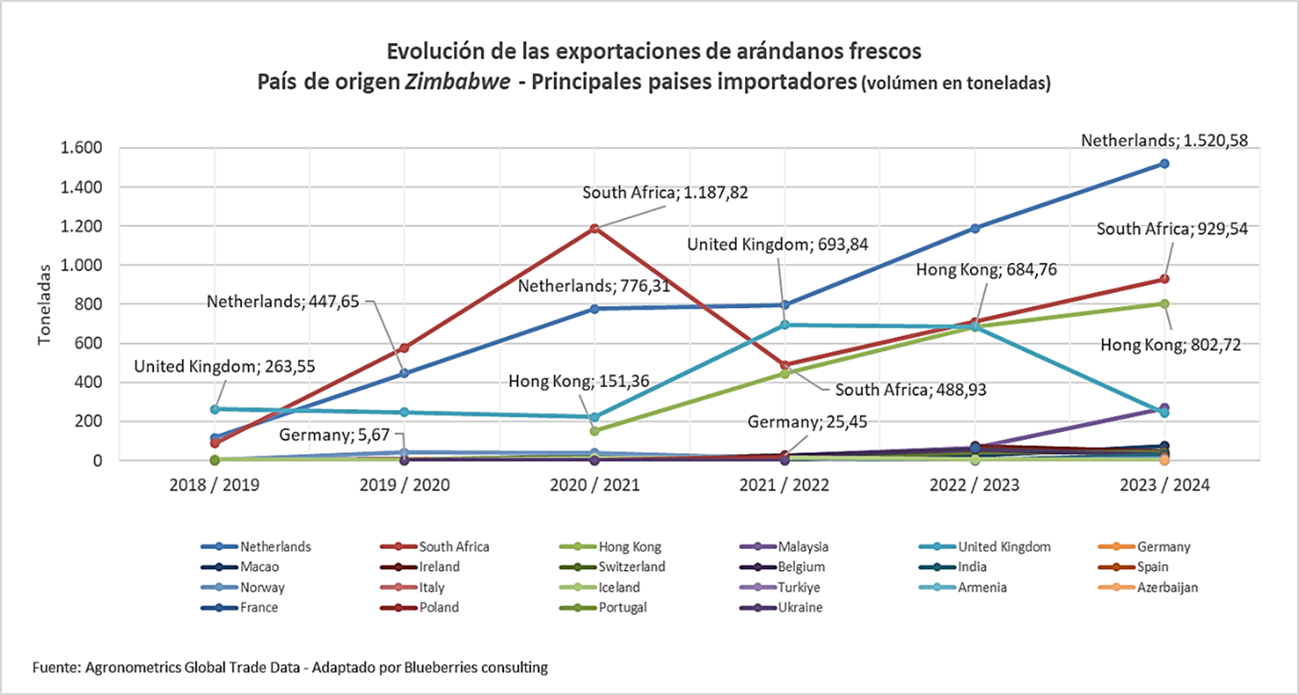
Zimbabwe's blueberry exports increased by 13.3%, from 3616 tons in the 2023/2024 season to 4096 tons in the 2024/2025 season (see Table 1). This only confirms sustained growth, considering that the 2018/2019 season began with 482 tons and continued to grow.
If we analyze the data by year of Agronometrics Global Trade Data and adapted by Blueberries Consulting. We found that exports increased by 67% in 2025 compared to the previous year, going from 3855 tons to 6451 (Table 2).
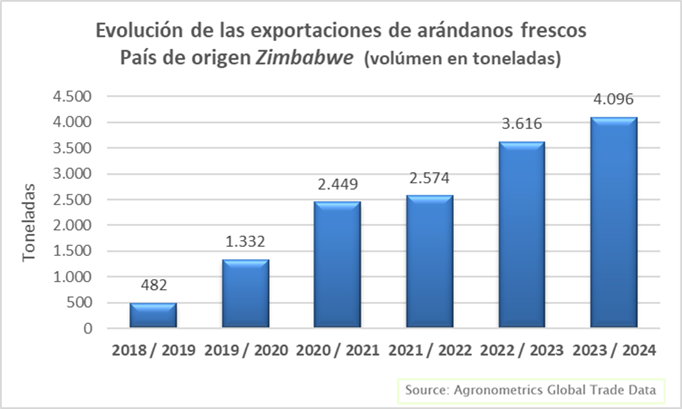
Evolution of exports by season (table 1)

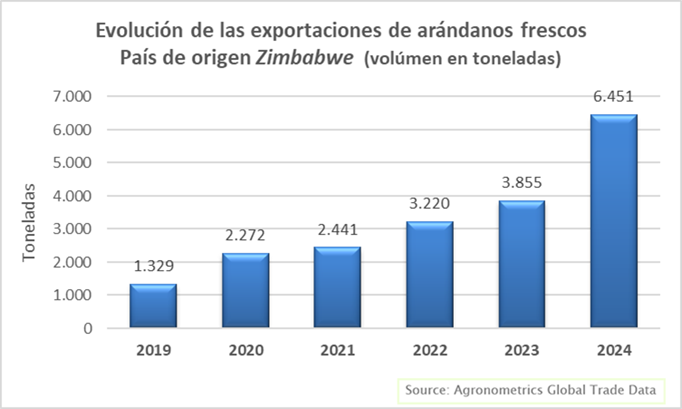
Evolution of exports by year (table 2)
Main markets
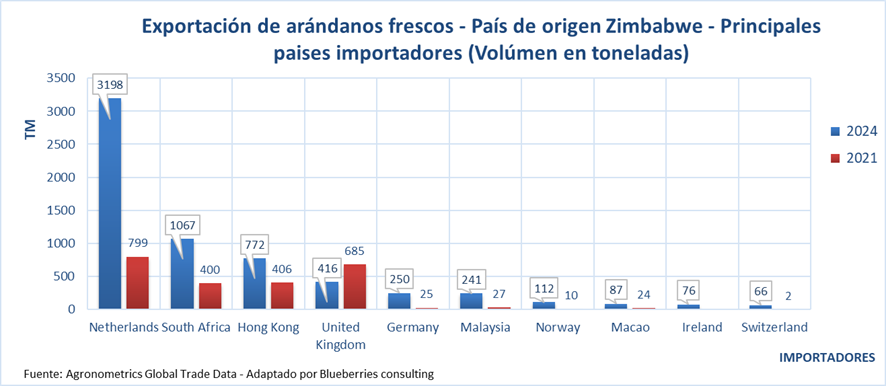
Currently, the main destinations for the fruit produced in Zimbabwe are the Netherlands, South Africa, Hong Kong, Malaysia, the United Kingdom and Spain (Tables 3 and 4).
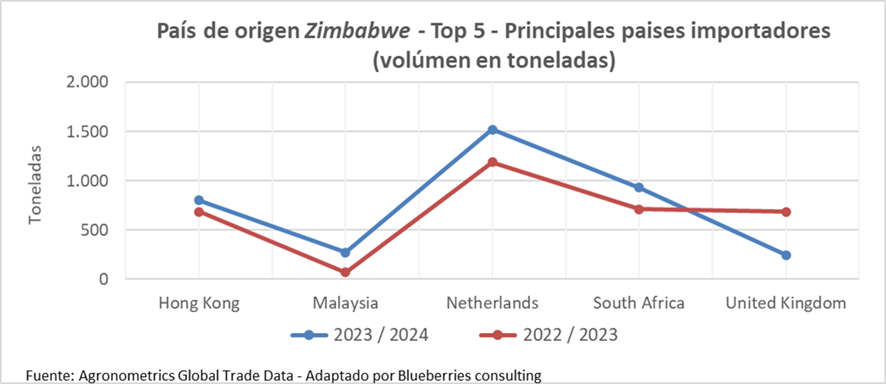
Main importing countries (table 3)
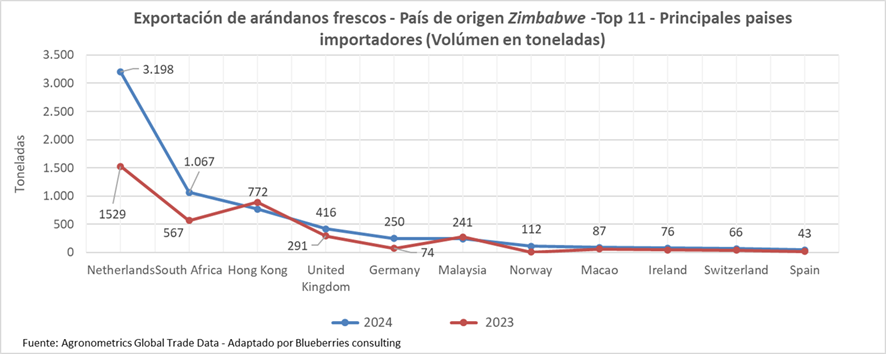
Top 11 importing countries (table 4)

In the Netherlands, exports were valued at $14,5 million in 2024, accounting for 29% of total exports. Hong Kong followed closely behind with imports worth $10,9 million (22%), while Germany imported berries worth $7,2 million, contributing 14% of the total. Hong Kong also offered the highest price per kilogram, at $14, followed by Singapore and Germany, at $12 and $9, respectively.
Challenges
And while the outlook for the blueberry industry looks positive for Zimbabwe, there are still hurdles to overcome, such as the erratic electricity supply affecting irrigation systems, the lack of cold chain infrastructure, and a labor shortage. These challenges must be addressed to strengthen its leading role in the blueberry industry.
Participate in the International Blueberry Seminars most important, and be part of the World Blueberry Tour!
To participate and learn more details about the XXXVIII Morocco Seminar 2025 enter the following link: XXXVIII International Seminar on Red Fruits
To purchase tickets click HERE
ARTÍCULOS RELACIONADOS